
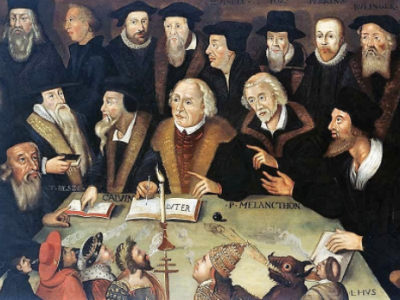
By Dr. Rafael Xavier Gonzalez
As missionaries, Catholics have been much more successful than non-Catholic Christians or Protestants. I’ll just go ahead and lump all Protestants together into a single genus, as does Alexander Gray Ryrie, the Protestant British history, scholar and author of the excellent book, Protestants: The Faith That Made the Modern World (2017). This work truly looks impartially into the history (and theology) of Protestantism. It is one of my favorite books on Protestantism written by a Protestant.
According to Ryrie, it is justified lumping Protestants into a single category. Even though there are differences, there is that which makes Protestants Protestants, besides the name which implies protesting (against the true Church of Christ, which is the Catholic Church, a name which originated with them I believe). The tenet of Sola Scriptura applied to the Bible is what essentially constitutes a Protestant:
“[Protestants]…refuse to let anyone else tell them how to read their Bibles. ‘I acknowledge no fixed rules for the interpretation of the Word of God,’ Martin Luther told Pope Leo X, ‘since the Word of God, which teaches freedom in all other matters, must not be bound.’ The following century, John Bunyan gently refused to submit to anyone else’s interpretation. ‘I am for drinking Water out of my own Cistern; what God makes mine by evidence of his Word and Spirit, that I dare make bold with.’ Protestants have been finding refreshment and boldness in their own cisterns ever since”.[1]
From Sola Scriptura other essential doctrines can be deduced that pertain to Protestantism, like their (traditional) notion of Sola Fide. But suffice for now to say that it is fair using the term Protestantism, referring a actual concrete reality. The point of this article is to address the (not so successful) missionary aspect of Protestantism, especially in the Americas.
The Catholic Church sought to convert and assimilate indigenous populations of the Americas. The institutional Church of Christ greatly supported exploration and colonization efforts by the Catholic nations of France, Portugal and Spain (You can check out Portuguese colonization efforts in Japan, highlighted in the popular FX TV show, Shogun). Protestants did not have this centralization in evangelization, since its very doctrine is decentralized, to the individual, and therefore disorder and chaos reigned. The Puritans were the first to come to the Americas and they were actually fleeing religious persecution (at least according to them), meaning that they did not necessarily have European support.
Yet the religious individualism of Protestantism incited them (and still does) to stress religious freedom in the New World. They were not so much motivated to spread their faith to the natives. Yet later Protestant colonists did intend and attempt at evangelization, but with little success, and not only in the Americas:
“…surprising as it may seem to modern eyes, Protestant colonists in America and across the world were in fact astonishingly slow to make any kind of sustained missionary effort. This is in striking contrast with their Catholic rivals. In Spain and Portugal’s burgeoning American, Asian and African empires, there were mass baptisms and sustained attempts over generations to nurture Catholicism. Protestants tried nothing of the kind”.[2]
Because of Protestant missionary inefficiency, demoralization naturally settled in and they ultimately totally began giving up. Catholics, seeing their success, were more and more animated to convert the natives. It is probably for that reason that they treated the native people more humanely, Catholics tended to mix with the native population over time and breeding was also seen as a way to convert people to European culture as means to bring them to Catholicism in the end. Meanwhile in the Protestant world, it was more common to drive native people out of the area so that white settlers could move in. This created a separation, making racial mixing far less likely, and hence creating racial tensions (manifested by segregation laws in the US, for example).
Not only in practice but in its very theology Protestantism opposed missionary activity:
“Many Lutherans were actually opposed to mission on principle. The classic proof text for missionary work was Christ’s so-called Great Commission to his apostles: ‘Go ye therefore, and teach all nations.’ Seventeenth-century Lutheran orthodoxy held that this instruction was intended specifically and exclusively for the apostles, not their successors. The theology faculty at Wittenberg formalized this position in 1651, adding that heathen peoples’ faithfulness was their own fault. Because the apostles did preach the Gospel to all nations, the heathens’ ancestors must have rejected it. They could not expect a second chance”.[3]
The Great Commission was still in force for most Calvinists. However, their extreme view on predestination, without God foreseeing your future merits, impeded missionary work. Why bother preaching to the heathen when their fate was already determined, foreordained by God? Yet many Calvinists did preach the Gospel out of pure duty. So while missionary activity for the Calvinists was a thing, their doctrine simply took the wind out of it. Catholic missionaries felt and feel the urgency of the Great Commission, in order to snatch souls from hell and bring them eternal life through Baptism and perseverance in grace.
Since Catholicism is the fullness of the truth and the actual revealed religion by Our Lord, it conforms to human nature. For that reason, it was easier for Catholics to evangelize than Protestants. Catholic missionaries knew how to purify pagan beliefs, not falling into a syncretism but rather inculturation (The Jesuits were masters at this and even the Protestants must recognize it). Since as Catholics we believe that nature is not fundamentally evil, it has elements that can lead us to the supernatural. Interestingly the very idea of supernatural means a building upon nature, a perfecting of the same, as opposed to something antinatural. Traditional Protestantism, stemming from its view of original sin’s total destruction of human nature, fell into a type of anthropological pessimism that made evangelization very difficult, if not impossible in some aspects. In the end, Catholicism is better equipped to convert pagans than Protestantism. Protestants actually struggled with the natives and their strong inclination to paganism and idol worship (it is true that currently Protestants are having success in converting Catholics, but not so with non-Catholics, generally speaking). They simply did not, and do not, know what to do.
Protestants simply did not, because they could not, master the art of conversion, though of course it is always the Holy Spirit that converts. Their notion of conversion was too culturally specific and rigid. To be fair, Protestantism was novel and hence inexperienced. Yet as Our Lord said, “For a good tree does not bear bad fruit, nor does a bad tree bear good fruit. For every tree is known by its own (Luke 6:43). The very fruits of Protestantism, and lack thereof, condemn it. For more information and concrete examples on Protestant missionary work, check out chapter 6 of Ryrie’s work.
It must be said that in Catholicism the act of faith must be a truly voluntary, interior act. It cannot be coerced physically (though of course this standard wasn’t always lived up to. This does not mean that a certain moral force is not warranted. In fact, it is precisely what Christ orders man in his Great Commission, to attempt to persuade people to become Catholic, giving a reason or explanation for your faith (cf. 1Peter 3:15). Because of the entire notion of Protestant faith as fiducial and subjective, why impose your individual subjective faith on another? As Catholics we believe that the faith that save us is an objective faith also, a dogmatic faith, since the faith is truly one (but this is a topic for another article).
I end this article with an illuminating post from the subreddit “AskHistorians” on Reddit. I transcribe it almost in its entirety:
“…I don’t think we can talk about Catholicism’s effect on blending European and Indigenous cultures and people without mentioning the Virgin of Guadalupe. In Catholicism, the Virgin Mary (mother of Jesus Christ) plays a very important role, but the story of Jesus takes place in the Middle East, far removed from the native population of the Americas. So, the story of the Virgin of Guadalupe is a tale of Mary, mother of Jesus, appearing to an Indigenous man living in New Spain (today’s Mexico) named Juan Diego in the 1500s. The apparition of Mary spoke to Juan Diego in his native language, one of the former Aztec Empire. Through these visions, she explained to him some aspects of Christianity and at one point helped heal his dying uncle. This story got written in the Aztec language Nahuatl and became a kind of localized scripture for indigenous people about Christianity, helping to convert them. It is believed that the story and the Virgin of Guadalupe character had many attributes that specifically appealed to native people over more traditional Christian stories and emblems. For example, because she appeared and healed the uncle, it somewhat deifies her (even though Mary is not a god in Christianity) which made Catholicism “feel” more like a polytheistic religion, which native people were more familiar with. Having her speak in Aztec languages and specifically appear to an indigenous man also helped the story appeal directly to native people. The blue, green and gold in Virgin of Guadalupe imagery also paralleled a lot of religious imagery from Aztec culture. (The Irish had a similar situation with St. Patrick and the story of him driving the snakes out of Ireland, which likely helped convert them to Catholicism too.) The Virgin of Guadalupe is also referred to as the “First Mestiza” and the “First Mexican”, making her a powerful symbol of a new identity that was the result of Europeans mixing with Indigenous Americans. Today she is still a very popular icon among Catholics in Central and South America”.[4]
[1] Protestants, pg. 31, Ryrie cites Luther and Bunyan. Italics from author.
[2] Protestants, pg 223.
[3] Protestants, pg 229.
[4] https://www.reddit.com/r/AskHistorians/comments/1d0m7gy/why_did_english_colonizers_not_mix_with_the/
