
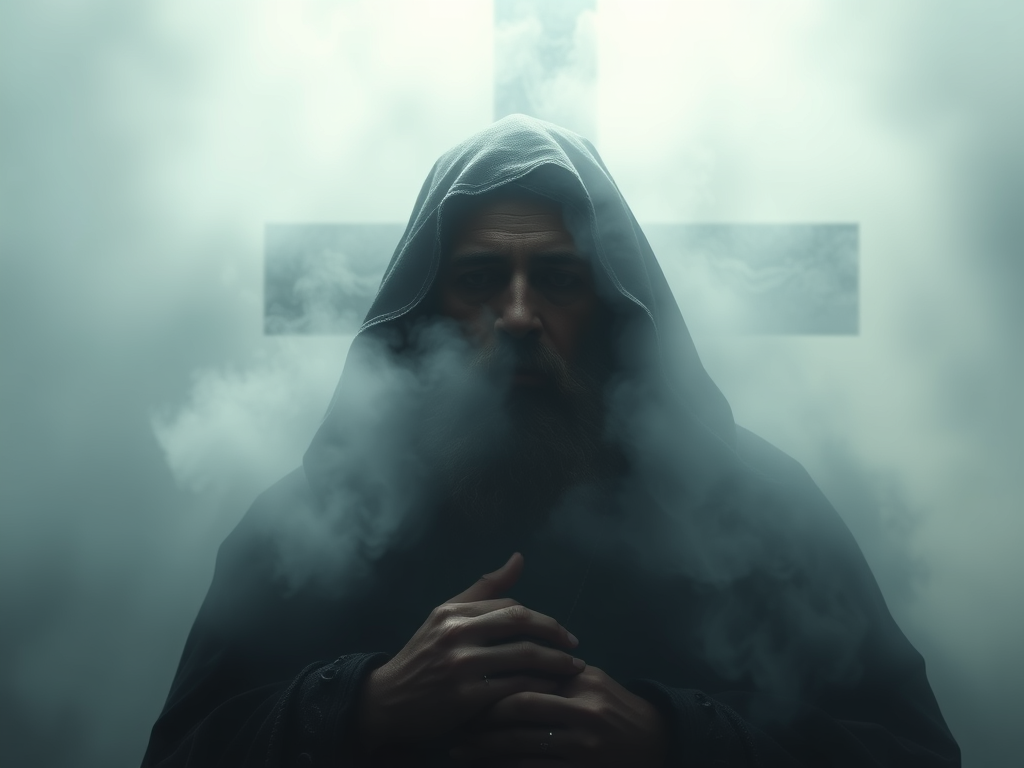
Because evil is not absolute, even our evil tendencies can be divinized somehow. God reveals his glory precisely by countering an evil tendency with that very same tendency, only sublimated into good, as the most Divine doctrine of the Cross manifests.
Today we live in a Nihilistic age, which of course is not good. Yet, even Nihilism, its underlying mentality, can shift towards goodness. In the age of digitalization, virtual reality, materialism and technology, there seems to be a reaction from the Gen Zrs to such a milieu that lacks the tangible, where fakeness reigns. This is a good sort of Nihilism, if I can utilize that word. There is wisdom in seeing all that is mutable and material as devoid of any transcendent meaning and value, without reference to something that immutable and immaterial. The problem of grounding is always an actual one.
This holy Nihilism points to the spirit of St. John of the Cross, the Spanish Carmelite mystic of the 16th century, a spiritual Doctor par excellence. Even though in the early centuries of Christianity you have the radically holy monks versed (and practiced) in spiritual doctrine, especially in the East, it is St. John of the Cross who probably provides the most thorough mystical doctrine rooted in reason and faith.
I personally remember, when I was discerning in a monastery some years back, that I had asked the superior for permission to read St. John of Cross’s writings. He told me that I better wait and grow more spiritually, as that doctrine can be detrimental for newbies in the spiritual life.
I also heard from a professor I had that Pope St. John Paul II, before becoming Pope, learned Spanish with the express intent of reading St. John of the Cross’s works, in order to write his PhD dissertation (“Faith according to St. John of the Cross”). Of course reading an author in their original language is optimal for better grasping what they wish to convey. As the old Italian saying goes, “Traduttori, traditori” (translators, traitors).
St. John of the Cross provides the radical doctrine that the young today are thirsting for. Everything is darkness in a sense and it is precisely in and through this darkness that God intends us to find Him. In his Ascend of Mount Carmel, John talks about how we must go through the dark night of the soul to journey to Divine union. But what does he mean by night? There are three divisions:
“We may say that there are three reasons for which this journey made by the soul to union with God is called night. The first has to do with the point from which the soul goes forth, for it has gradually to deprive itself of desire for all the worldly things which it possessed, by denying them to itself; the which denial and deprivation are, as it were, night to all the senses of man. The second reason has to do with the mean, or the road along which the soul must travel to this union—that is, faith, which is likewise as dark as night to the understanding. The third has to do with the point to which it travels—namely, God, Who, equally, is dark night to the soul in this life. These three nights must pass through the soul—or, rather, the soul must pass through them—in order that it may come to Divine union with God”.[1]
The first cause of this night, namely, depriving yourself for the appetite for worldly possessions is a common theme among the mystics, though this is a truth that can be obtained through reason alone.
Jumping to the second cause, John of the Cross, though believing that God’s creation is good, stressed that our desires for them impede our union with God; their acquisition is not a (proximate) means of attaining God, but rather their rejection (as proximate) is the right way:
“The reason is that two contraries (even as philosophy teaches us) cannot coexist in one person; and that darkness, which is affection set upon the creatures, and light, which is God, are contrary to each other, and have no likeness or accord between one another, even as Saint Paul taught the Corinthians, saying: Quoe conventio luci ad tenebras? That is to say: What communion can there be between light and darkness? Hence it is that the light of Divine union cannot dwell in the soul if these affections first flee not away from it.
In order that we may the better prove what has been said, it must be known that the affection and attachment which the soul has for creatures renders the soul like to these creatures; and, the greater is its affection, the closer is the equality and likeness between them; for love creates a likeness between that which loves and that which is loved”.[2]
It is love that makes equality and similitude. Yet not only the senses cannot serve as the proximate means for divine union with God, no creature or knowledge comprehensible to the intellect can serve as a proximate means. Along with Scripture, John of the Cross uses reason to argue his position:
“…all means must be proportioned to the end; that is to say, they must have some connection and resemblance with the end, such as is enough and sufficient for the desired end to be attained through them. I take an example. A man desires to reach a city; he has of necessity to travel by the road, which is the means that brings him to this same city and connects him with it. Another example. Fire is to be combined and united with wood; it is necessary that heat, which is the means, shall first prepare the wood, by conveying to it so many degrees of warmth that it will have great resemblance and proportion to fire. Now if one would prepare the wood by any other than the proper means — namely, with heat — as, for example, with air or water or earth, it would be impossible for the wood to be united with the fire, just as it would be to reach the city without going by the road that leads to it. Wherefore, in order that the understanding may be united with God in this life, so far as is possible, it must of necessity employ that means that unites it with Him and that bears the greatest resemblance to Him”.[3]
We know that we cannot live without created things, yet we have to use them orderly, within reason illuminated by faith. Properly utilizing creatures can only be a remote means for Divine union, while only faith is the proximate way. For St. John of the Cross, faith must bring us to contemplation, surpassing meditation that is discursive and rooted in our sense faculties (interior senses), like the imagination and the memory. This is the real darkness we must enter, where man becomes passive and God active in man’s life, taking possession of him.
Faith is definitely a dark act in that it is believing without evidence, without seeing: “Thomas, because you have seen Me, you have believed. Blessed are those who have not seen, and have yet believed.”[4] Faith is intellectual assent to what God has revealed, He who can neither deceive nor be deceived. It is precisely because of this darkness in the material realm, in the world of the senses, that faith becomes a true light for us, a guiding light to God, in the spiritual life. This sound dualism is the doctrine that St. John of the Cross, and really all faithful Catholic Christians, espouse. The Catholic synthesis is at play here, the harmonized paradox: faith is a dark night for us yet it illumines the very soul that is in darkness.
We live in an intense information age, when we are overwhelmed by all types of information and knowledge, due to novel technological means of communication, like social media for example. We have lost recollection or only retain it through great difficulty and mortification. We so desperately need the doctrine of St. John of the Cross in order to obtain true inner peace which is synonymous with union with God, our true end. We must enter into the “nothingness”, the essence of his doctrine. I end with his famous poem and then a canticle:
“To come to enjoy everything seek enjoyment in nothing.
To come to possess everything seek to possess nothing.
To come to be everything seek to be nothing.
To come to know everything seek to know nothing.
To come to what you do not taste go to where you taste nothing.
To come to what you do not know go to where you know nothing.
To come to what you do not own go to where you own nothing.
To become what you are not go to where you are nothing.
If you linger somewhere you will never conquer the whole.
To come wholly to the whole you must leave the whole.
And if you come to where you can grasp the whole, have it without wanting to have it.
For if you want to hold fast to only something of the whole, so you will not have your treasure purely in God”.[5]
“In order to arrive at having pleasure in everything,
Desire to have pleasure in nothing.
In order to arrive at possessing everything,
Desire to possess nothing.
In order to arrive at being everything,
Desire to be nothing.
Desire to know nothing.
In order to arrive at that wherein thou hast no pleasure.
Thou must go by a way wherein thou hast no pleasure.
In order to arrive at that which thou knowest not,
Thou must go by a way that thou knowest not.
In order to arrive at that which thou possessest not,
Thou must go by a way that thou possessest not.
In order to arrive at that which thou art not,
Thou must go through that which thou art not”.[6]
[1] The Ascent of Mount Carmel, Bk I, Ch. 2.
[2] Ascent, Bk I, Ch. 4.
[3] Ascent, Bk II, Ch. 8.
[4] John 20:29.
[5] From the poems of John of the Cross from The Ascent of Mount Carmel.
[6] Ascent, Bk I, Ch. 13.
