by Dr. Rafael Xavier Gonzalez
Traditionally, Catholics held Islam or Mohammedism to be a Christian heresy, a militant Arianism since it believed and still believes in Jesus as a mere prophet, not actually Divine, the true natural Son of God the Father. It was, and essentially is, militant because it basically spread by the sword, though Islamophilic Academia has attempted to suppress such a clear historical reality. So-called Islamophobia is not a fabricated hateful position just based on whim or arbitrary discrimination. Fear of Muslims was, and is in a sense, totally justified as Catholics living in the time of Islamic conquest have attested to, interestingly according to prior prophecies:
“A theologian and a monk who wrote in the immediate aftermath of Arab invasions (between 634 and 640), Maximus decried the invaders as ‘a barbarous nation of the desert overrunning another land as if it were their own! To see our civilization laid waste by wild and untamed beasts which have merely the shape of a human form!’. Also in the East (Melkite), the late seventh-century Syriac text known as Pseudo-Methodius’s Apocalypse (ca. 692 but purportedly written in 311) reiterates the same views. In this work the invasion of the pagan Ishmaelites is ‘foretold’ as the scourge of God- and Christians must repent”.[1]
It was the great Hilaire Belloc (1870-1953) who mentioned Islam as an important heresy in his book, The Great Heresies. Yet Islam is different from other heresies:
“It did not rise within the Church, that is, within the frontiers of our civilization. Its heresiarch was not a man originally Catholic who led away Catholic followers by his novel doctrine as did Arius or Calvin. He was an outsider born a pagan, living among pagans, and never baptized. He adopted Christian doctrines and selected among them in the true heresiarch fashion. He dropped those that did not suit him and insisted on those that did which is the mark of the heresiarch but he did not do this as from within; his action was external”.[2]
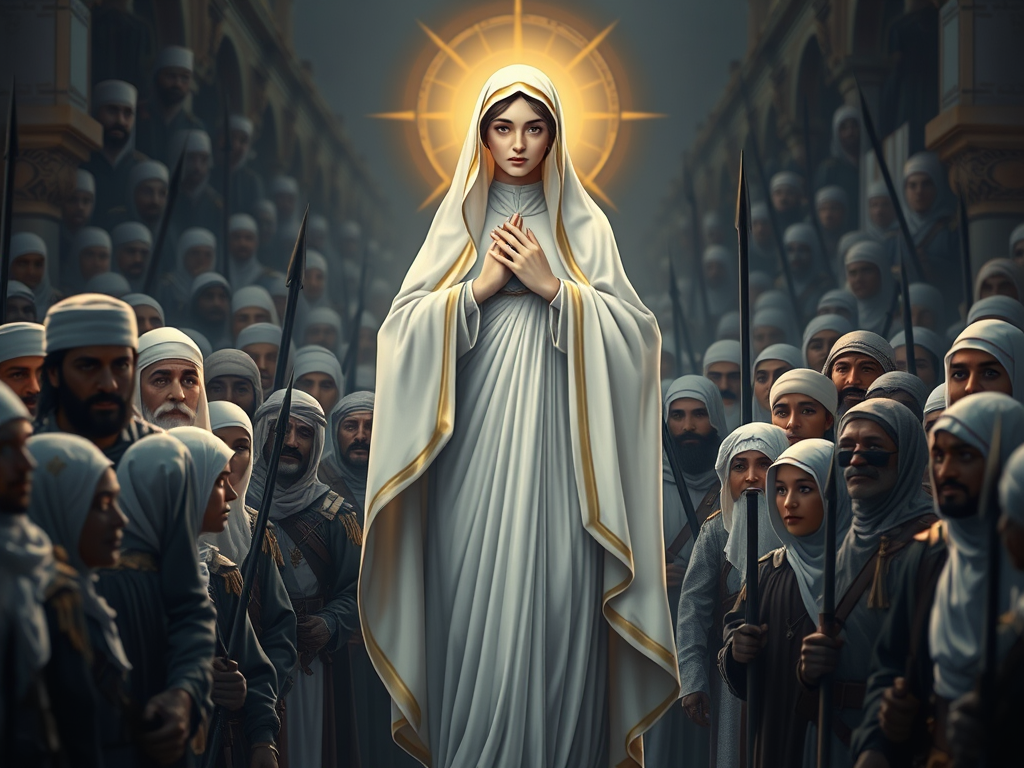
In a chapter from Bishop Fulton Sheen’s book, The World’s First Love, titled, Mary and the Moslems, the good Bishop exhorts Catholics to evangelize Muslims by means of Mary Most Holy. It is very hard for a Muslim to become a Christian, for it would be like a Christian becoming a Jew, since Muslims believe that Islam fulfills both Judaism and Christianity. But for Blessed Mary nothing is impossible!
But why Mary? Because according to Muslims sources, especially their main source, the Quran, Mary is the greatest and hence most honored among all women. Strangely the mother of Jesus is highly regarded and praised for her virtue and holiness, while Muhammad, the greatest and last prophet according to Islam, in certain hadiths such as those found in Sahih Muslim, report that Muhammad himself stated his father was in hell, and that he was not permitted to pray for forgiveness for his mother because she died as a disbeliever (though some Muslims scholars consider this to be a so-called weak hadith).
Here’s a list of various passages from the principle surahs and verses from the Quran about Mary, the mother of Jesus (Maryam):
1. Surah Al-Imran (Chapter 3)
- 3:35–37 – The story of Mary’s mother dedicating her unborn child to God’s service; Mary’s early life in the sanctuary under the care of Prophet Zakariya.
- 3:42–47 – Angels announce to Mary that she is chosen above all women, and will miraculously conceive Jesus (Isa).
- 3:49–52 – The mission of Jesus as a prophet is foretold, with Mary central to his miraculous birth.
2. Surah Maryam (Chapter 19)
- 19:16–36 – The most detailed and beautiful narrative of Mary’s life:
- Her seclusion.
- The angel (often interpreted as Gabriel) announcing the birth of a son.
- The miraculous birth of Jesus.
- Infant Jesus speaking from the cradle to defend his mother’s honor.
3. Surah An-Nisa (Chapter 4)
- 4:156–158 – Reaffirms Mary’s purity and condemns those who slander her (Immaculate Conception?); also discusses the crucifixion.
4. Surah Al-Mu’minun (Chapter 23)
- 23:50 – Mentions Mary and her son as a sign from God, highlighting their elevated status.
5. Surah Al-Ma’idah (Chapter 5)
- 5:110 – God reminds Jesus of the favors given to him and his mother Mary.
6. Surah At-Tahrim (Chapter 66)
- 66:12 – Describes Mary as the example of a devout woman who guarded her chastity, believed in God’s words, and was obedient.
Even more fascinating is the Muslim connection with Fatima, Portugal and hence obviously, with arguably the greatest Church-approved private revelation and apparition of the Virgin Mary to three shepherd children in this very small village town in 1917, namely, Our Lady of Fatima, though she called herself Our Lady of the Rosary. Here I transcribe the tremendous history of Fatima, as narrated by Chanoine Barthas and G. da Fonseca:
“In 1158, when half of Portugal was still under the Mohammedan yoke, a brilliant cavalcade of Moorish youth of both sexes left the castle of Alcacer do Sal, in the early morning, going towards the River Sado for a day’s rejoicing. But they marched straight into a Portuguese ambuscade under the command of the fearless leader, Gonzalo Hermingues. Most of the Moorish cavaliers fell bravely in the fight, and the ladies of escort were brought to Santarem to be presented to the king, Don Alfonso Henriques, then warring against the Saracens.
The king praised the bravery of his knights and asked their leader what reward he desired. ‘The honor of having served you. Sire’, was his reply, ‘and in memory of this day I would beg for the hand of Fatima.’ That was the name of the noblest and most beautiful of the captives, the daughter of the vali or governor general of Alcacer. ‘Good!’ answered the monarch, ‘on condition that young princess freely accepts our holy faith and consents to be your wife.’ Fatima accepted. She received instruction and was baptized under the name of Oureana. The marriage was celebrated, and the king gave Don Gonzalo, as a wedding gift, the city of Abdegas, henceforth called Oureana (the modern Ourem).
The beautiful princes died in the flower of youth. Broken hearted, Gonzalo gave himself to God in the Cisterian Abbey of Alcobazo, and from that abbey, a few years later, a monastery was founded in a neighbouring mountain village. Father Gonzalo was named superior. As soon as the chapel was built, he had the remains of Oureana buried there, where they may still remain, though unmarked. But the place bears her name: Fatima. The chapel, with the changes of centuries, is the actual parish church”.[3]
Beautiful history! What a fascinating Providential intersection between Islam and Catholicism! Mere coincidences are for atheists! For those who believe in God, He is clearly revealing something here. It is important to mention that Fatima was the daughter of Muhammad and honored as the greatest of all women, next to Mary. Both Sunni and Shi’a Muslims are devoted to her memory. She is actually central to the Shi’a theology, serving as a symbol of justice and strength, the perfect woman.
So again Our Lord is telling us something here, something illuminating that must animate our evangelization efforts with Muslims:
“Missionaries in the future will, more and more, see that their apostolate among Muslims will be successful in the measure that they preach Our Lady of Fatima…The Muslims have a devotion to Mary, our missionaries should be satisfied merely to expand and to develop that devotion, with the full realization that Our Blessed Lady will carry the Muslims the rest of the way to her Divine Son”.[4]
There are clear concrete examples of these kind of efforts already giving fruits of conversion:
“The final evidence of the relationship of the village of Fatima to the Muslims is the enthusiastic reception that the Muslims in Africa and India and elsewhere gave to the pilgrim statue of Our Lady of Fatima…Muslims attended the church services in honor of Our Lady; they allowed religious processions and even prayers before their mosques; and in Mozambique the Muslims, who were unconverted, began to be Christian as soon as a statue of Our Lady of Fatima was erected”.[5]
These end times are the times of Our Lady in which her role transitions from a hidden and humble role in primitive Christianity to a more explicit and manifest role (multiple private revelations reported), though of course her role was always crucial as the Mediatrix of all graces, giving us the Grace of all graces, Jesus Christ Our Lord.
Honoring Mary sincerely will automatically end up in honoring Christ. It’s simply mathematical. She is the perfect aqueduct that brings us the water of grace which is nothing other than Christ living in us, our christification in grace.
Let us be motivated to assume such a task in our words and actions towards Muslims, especially in our explicit apostolates, remembering the teachings of St. Luis Grignon de Montfort, from his True Devotion, namely, that devotion to Mary is a necessary means to arrive at our last end Christ Himself. For any devotion that does not terminate in Christ is from the devil and must be rejected, and no one understands and lives this truth out more than Our Blessed Mother Mary. Amen.
[1] Frank, Maria Esposito, “Dante’s Muhammad: Parallels between Islam and Arianism”, Dante Studies, with the Annual Report of the Dante Society, no. 125 (2007): 185–206, p. 188.
[2] Hilaire Belloc, The Great Heresy, fisheaters.com.
[3] Narrated by Chanoine Barthas and G. da Fonseca, cited from: Ali Murat Yelt, Fatima, The Pope and Mehmet Ali Agca”, Islamic Studies 32, no. 4 (1993): 447–60, p. 449.
[4] Bishop Fulton Sheen from his book The World’s First Love, taken from the following book: Jacques Jomier, O.P., The Bible and the Quran, trans. by Edward P. Arbez (San Francisco: Ignatius Press, 1959), 125.
[5] Ibid., 124.
