
By Dr. Rafael Xavier Gonzalez
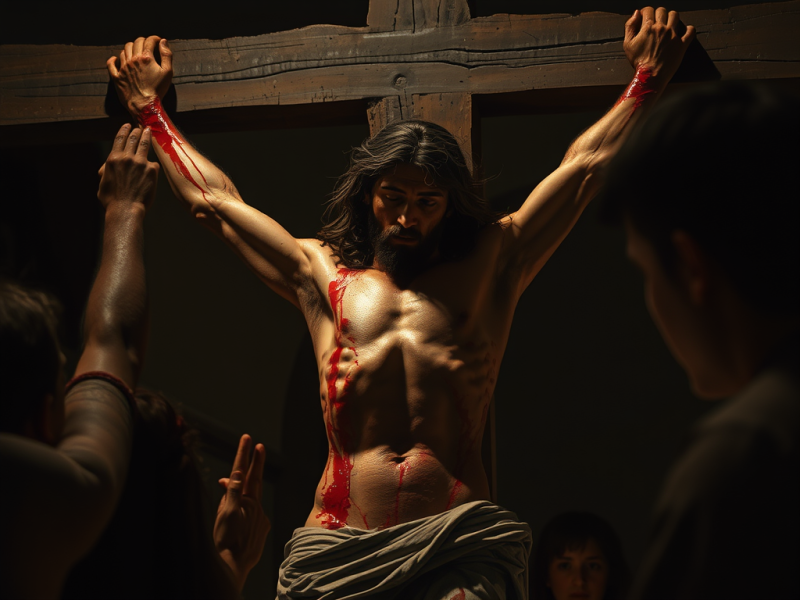
Only in Catholicism, and not in mere generic Christianity, can one establish the doctrine of Divine charity. While all reject the symbol of the crucifix as a sign of God’s love and reminder of his presence in his members, in the Militant Church, The Catholic Church (the Orthodox also) clings on to her crucified Savior represented in the crucifix, for there is no cross without Christ and no Christ without a cross.
Our Lord Jesus Christ is the antithesis to the values of our current secular culture, devoid of love: “because of the increase of wickedness, the love of many will grow cold” (Mt. 24:12). Let us be reminded of what St. Paul says about people in the end times, and may God save us from such a spirit:
“But understand this, that in the last days there will come times of difficulty. For people will be lovers of self, lovers of money, proud, arrogant, abusive, disobedient to their parents, ungrateful, unholy, heartless, unappeasable, slanderous, without self-control, brutal, not loving good, treacherous, reckless, swollen with conceit, lovers of pleasure rather than lovers of God, having the appearance of godliness, but denying its power. Avoid such people” (2 Tim 3:1-5).
For that reason, the month of June must be fully retaken as dedicated to the Sacred Heart of Jesus in order to combat, not only secularism, but the ever-increasing explicit satanism that is making itself gradually mainstream. Satanism, especially movements like the TST and the Church of Satan, are ardent defenders of so-called pride month, pride being the sin of all the sins. These groups claim to rebel against authority. Allying with the LGBTQ+ (especially the “T”), they have rebelled against the authority of nature itself, rooted God ultimately. Satanism and pride are explicitly opposed to true love, and only love defeats evil. The source of love subsists in the Sacred Heart, as Pope Saint John Paul II elaborated in his homily in the Apostolic Journey to Poland, closing of the 2nd Plenary Synod of Poland in Warsaw:
“The Sacred Heart of Jesus is precisely the image of this infinite and merciful love which the heavenly Father has poured out upon the world through his Son, Jesus Christ…Only love, revealed by the Heart of Christ, can transform the human heart and open it to the whole world, making the world more human and more divine. A hundred years ago, Pope Leo XIII wrote that in the Heart of Jesus ‘we need to place all our hope. In him we must seek and from him we must expect the salvation of all people’ (Annum Sacrum, 6) I too exhort you to renew and nurture devotion to the Sacred Heart of Jesus. To this ‘Fount of life and holiness’ draw individuals, families, parish communities, and all elements of the Church that they may obtain from him ‘the unsearchable riches of Christ’ (Eph 3:8). Only those who are ‘rooted and grounded in love’ (ibid., 3:17) can oppose the civilization of death and, upon the ruins of hatred, contempt and force, build a civilization which springs from the Heart of the Savior.
In our families, and even in society, we need to exteriorize the devotion to the Sacred Heart of Jesus, a heart so imbued with the love of man yet so torn due to the scorn and ingratitude received from men. Pius XII reminds us that the Sacred heart is a gift from God to man:
“The Church, rejoicing in this inestimable gift, can show forth a more ardent love of her divine Founder, and can, in a more generous and effective manner, respond to that invitation which St. John the Evangelist relates as having come from Christ Himself: “And on the last and great day of the festivity, Jesus stood and cried out, saying, ‘If any man thirst, let him come to Me, and let him drink that believeth in Me. As the Scripture saith: Out of his heart there shall flow rivers of living waters.’ Now this He said of the Spirit which they should receive who believed in Him’”.[1]
Hence celebrating so-called pride month during the month of June is a total offense, a sacrilege, to Our Lord. Not only is it a denial to respond to God’s love for us, manifested in the Sacred Heart of Jesus, but it a slap in the face of God. It is literally living an anti-Christian life. Therefore pride month celebrators and supporters have another as their father, namely, the devil. Let us recall the words of Jesus to the crowd that did not believe in him nor his works:
“Why is my language not clear to you? Because you are unable to hear what I say. You belong to your father, the devil, and you want to carry out your father’s desires. He was a murderer from the beginning, not holding to the truth, for there is no truth in him. When he lies, he speaks his native language, for he is a liar and the father of lies” (John 8:43-44)
I have always been edified by the shepherd child and seer, St. Francesco, who like Lucia and St. Jacinta, was called directly by Our Lady of Fatima (though she called herself “Our Lady of the Rosary”) to do penance for the conversion of sinners for Our Lord was deeply offended. Francesco was motivated more to do penance—and great penances he did—not so much for the conversion of sinners, but rather to console our sad Lord.
We as Catholics have seemed to have lost this essential aspect of Our Faith, namely, consoling our deeply offended God. This is probably one of the most profound mysteries of God since even reason can know that He is by nature impassible, that is, not affected by external forces that cause suffering in the human sense, for this would seem to imply certain imperfection. Yet somehow the Sacred Heart of Jesus gives us a glimpse into this mystery, the mystery of God himself being able to be (emotionally) moved somehow. God is never indifferent and emotionally detached from his creatures. Since love is essentially tied with suffering, God’s love allows Him to share in human suffering (Catholics are theists, while Protestants are deists, at least in a veiled manner).
St. Bernard of Clairvaux clarifies that even though God is not moved he is “conmoved” not by being overcome by suffering, but through His love and compassion, which leads Him to share in suffering and offer hope and rest to man, symbolized in the pierced heart of Christ. God is the most sensitive of all beings.
The heart is not only the universal sign of love, but it is also the symbol of suffering. Both love and suffering are heartfelt and sometimes even literally so (there seems to be an actual feeling in the heart area). Deep love for Christ brings about a desire to suffer for Him, as St. Margaret Mary Alacoque would express to her spiritual father, Fr. Croiset:
“Nothing in this world is capable of pleasing me except the Cross of my divine Master, a Cross like His Own, heavy and ignominious without sweetness or consolation or relief. Let other people be so fortunate as to accompany my divine Savior in his ascent to Thabor; for my part I wish to know of no other road but that to Calvary, for nothing but the Cross has any attraction for me. My lot will be, then, to be on Calvary until my last sigh, amidst the scourges, the thorns, the nails, and the Cross, without consolation or pleasure but that of having none”.[2]
Christ must be known in a practical sense, that is by works of love animated by his divine grace. Just as man’s faculties of intellect and will are closely related and collaborative, we must gain knowledge through the affections of the will, through love, and let us act on it to manifest and augment our interior devotion to Christ. Love is the best source of knowledge. Check out this illuminative liturgical note:
“Of all devotions, devotion to the Sacred Heart was, and remains, one of the most widespread and popular in the Church. Understood in the light of the Scriptures, the term ‘Sacred Heart of Jesus’ denotes the entire mystery of Christ, the totality of his being, and his person considered in its most intimate essential: Son of God, uncreated wisdom; infinite charity, principal of the salvation and sanctification of mankind. The ‘Sacred Heart’ is Christ, the Word Incarnate, Savior, intrinsically containing, in the Spirit, an infinite divine-human love for the Father and for his brothers”.[3]
I end by mentioning St. Bernard’s four stages of love in his On Loving God (ch. 7): first, love of self for self’s sake; second, love of God for self’s sake; third, love of God for God’s sake; fourth, love of self for God’s sake. In this last degree, the self-love is purified and purely oriented towards God. God is sought to be pleased in all things since all things are lived in His Light. Teach me how to love you Lord and educate me in the Cross.
[1] Pius XII, encyclical Haurietis Aquas, #3.
[2] Fr. John Croiset, The Devotion to the Sacred Heart of Our Lord Jesus Christ, p. 8.
[3] Directory on Popular Piety and the Liturgy: Principles and Guidelines 166 / Congregation for Divine Worship and the Discipline of the Sacraments.
