By Dr. Rafael Xavier Gonzalez
There was a recent debate between Ubi Petrus and Voice of Reason (you can see it here: https://www.youtube.com/watch?v=UPyHjZILcBU&t=131s) which put the Eastern Orthodox position on the defensive (they are usually on the offensive). The question was if the Eastern Orthodox church is the “One, Holy, Catholic and Apostolic Church”, the four marks of the Church established by the Council of Nicaea (325 AD), from the Nicene Creed, and affirmed and further developed by the First Council of Constantinople (381 AD). These marks are the essential characteristics of the Church as founded by Jesus Christ Our Lord.
Voice of Reason argued that the Orthodox church lacks both unity and catholicity (it is interesting that he said it was holy). The Orthodox Church is not united in faith, liturgy and governance, he said. The OC is not Catholic because it is more nationalistic and is restricted to certain regions of the world.
The problem is that in the history of the Church, the Roman Catholic Church, the same concrete claims of disunity can be applied to it, like the great schisms, Avignon and the Western Schism come to mind. Disunity existed on the surface while the true Church remained united in a more profound sense that transcends the mere concrete events in history (in another article I will address the meaning of the mark of unity). What VOC was arguing though is that the principle of unity is lacking is the OC. There is no physical, external head of all of Eastern Orthodoxy. All the Patriarchs and/or Metropolitans do not have any clear, visible unifying factor that can be appealed to (outside the Roman Pontiff of course, but they do not want to admit this).
The point of this article is to show that the Pope defended the orthodoxy (lower case “o”), especially the Council of Chalcedon (451), an essential council for both Catholics and Orthodox alike. Eastern Orthodoxy would not be orthodox or doctrinally sound without the interventions of the Roman Popes. There are innumerable references in ecclesiastical history to illuminate this point but I want to address briefly the issue of Chalcedon.
It must be said though, that the western Roman Church has heavily relied on the East for its foundational Trinitarianism and Christology, since the first eight ecumenical councils, recognized by both East and West, were from the East. There is no doubting the theological and spiritual contribution of the Eastern Church:
“We believe that the venerable and ancient tradition of the Eastern Churches is an integral part of the heritage of Christ’s Church, the first need for Catholics is to be familiar with that tradition, so as to be nourished by it and to encourage the process of unity in the best way possible for each” (Apostolic Letter Oriental Lumen #1).
What’s kind of funny yet sad is that, while Catholics seem more open to unity with Orthodox, the same cannot be said the other way around. In fact, some prominent Orthodox leaders think that Rome has fallen into heresy and even that they need to be rebaptized! (Check out this latest video: https://www.youtube.com/watch?v=clLn41n_Gqw). I guess the heresy of Donatism hasn’t been settled for them. But I digress.
Thanks to the Great Pope Leo I (440-461), the so-called “robbery” council of Ephesus, Ephesus II, not a recognized ecumenical council by the Catholic Church, was also ultimately rejected by the Eastern Orthodox Church (though the minority, so-called Oriental Orthodox churches accept it). In this synod (not council), the heretical Monophysitism—single-nature theology—was defended, while the essential doctrine of Pope Leo, from his famous Tome, was rejected. In it Pope Leo Beautifully articulates the reality of the mystery of Christ:
“…One and the same Christ, Son, Lord, only-begotten, acknowledged in two natures which undergo no confusion, no change, no division, no separation; at no point was the difference between the natures taken away through the union, but rather the property of both natures is preserved and comes together into a single person and a single subsistent being; he is not parted or divided into two persons, but is one and the same only-begotten Son, God, Word, Lord Jesus Christ, just as the prophets taught from the beginning about him, and as the Lord Jesus Christ himself instructed us, and as the creed of the fathers handed it down to us”.
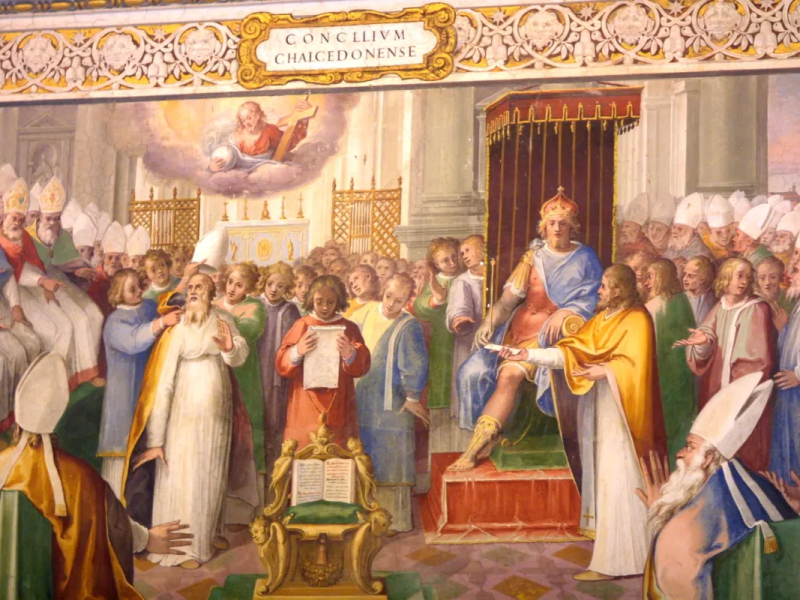
The Council of Chalcedon (451) is no doubt one of the most important councils of the Church especially regarding its precise Christological definition of Jesus being true God and true man, two natures hypostatically united in the sole Divine Person (I like to say that Jesus is one “who” with two “whats”). The council is the result of the Pope’s rejection of the pseudo-council Ephesus II and his urging of a new one in which, in the end, the doctrine of Eutyches and Dioscorus of Alexandria (Monophysitisim basically) were condemned. Chalcedon is known for the famous phrase cried out by the bishops: “Peter has spoken through the mouth of Leo”. Thus the Eastern Orthodox recognize Chalcedon, thanks to Pope Leo I and his successors.
In the twenty-eighth decree of the council, one that infuriated Leo, the artificial exaltation of the Patriarchal of Constantinople was said to have “equal privileges to the most holy throne of New Rome, justly judging that the city which is honored with the Sovereignty and the Senate, and enjoys equal privileges with the old imperial Rome, should in ecclesiastical matters also be magnified as she is, and rank after her”. The motive of this decree was mainly due to the growing political superiority of the Eastern empire over the Western empire, which was close to its demise (it fell around 476 A.D.). The audacity of the East to raise itself to second to Rome—notice not even on its level of authority—was purely based on political motives. One can argue that even their charges of heresy, like the Filioque and the use of unleavened bread later on, was also politically based, since these, among other doctrinal issues, were not even deemed heretical until centuries afterward (!). The whole background story leading up to the Eastern Schism in 1054 is quite illuminative and actually makes no sense from a doctrinal point of view. In other words, it really wasn’t doctrine that separated East and West, but rather it was an unjustified excuse for political superiority by the East that animated the Schism. Just read the history of it. An impartial reading will show this.
The following up to the fall of the Western Empire, the East struggled to maintain orthodoxy because of the Monophysite strongholds, promoted by the Monophysite emperor himself, Basiliscus (475-476). The patriarch Acacius of Constantinople (472-489) sought to write a compromise document with the Monophysites called the Henotikon or Edict of Reunion (Zeno was the emperor at this time, and he was also anti-Chalcedonian). In it, there was no mention of Leo’s Tome, which provided the foundational Christological doctrine, and hence Rome could not even contemplate accepting the Henotikon. The East, Constantinople as the exemplar, fell into heresy (interestingly also the whole iconoclasm heresy was an eastern problem, not a western one. Some say that it was incited by Islamic influence).
Pope Felix III (483-492) was actually the first pope to send legates to inform the emperor of his election, a practice that many subsequent popes kept. Pope Felix III put his legates on trial when they returned to Rome because they did not object to a known Monophysite, Peter Mongus, from formally being “added to the diptychs”, which means to be offically placed on a list of living or dead bishops recognized as orthodox and who would thereafter be commemorated in the solemn liturgical celebrations. Pope Felix, following his predecessors, refused to accept the unpopular Henotikon and eventually excommunicated the Patriarch Acacius, who in turn excommunicated Pope Felix, initiating the Acacian Schism. It is clear who is in the right and who was in the wrong. But again, as Catholics we appeal to the Pope and the bishops united to him. Who do the Eastern Orthodox appeal to?
A lot more can be said about the aforementioned schism and other instances in Church history. The point is that Rome has held the orthodox faith and has allowed, both in principle and in praxis, the Orthodox to be orthodox. For without Chalcedon, Eastern Orthodoxy would be reduced to the current heretical Oriental Orthodox (Coptic, Syriac, Armenian, Ethiopian, Eritrean, and Indian Orthodox Churches). Without the one true Church you end up with churches.
