Dr. Rafael Xavier Gonzalez
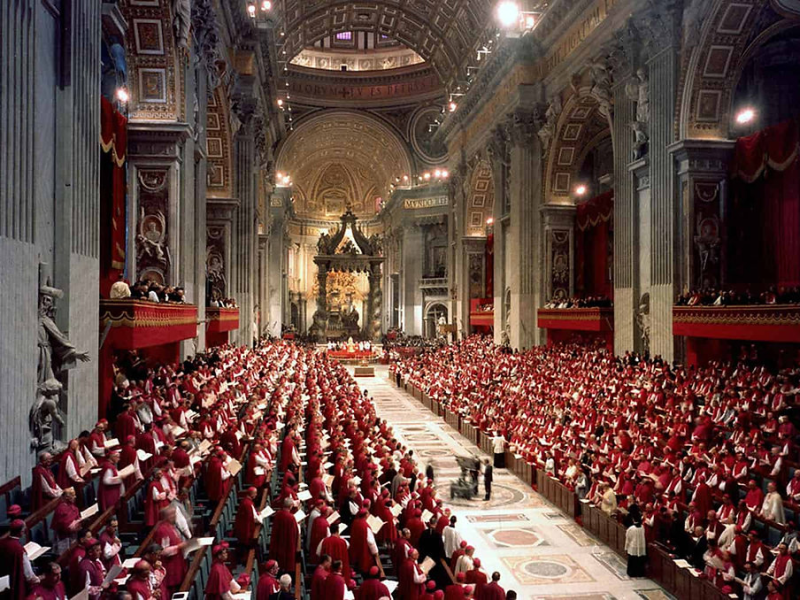
The Church has always believed in the essential unity of Tradition and Scripture, a belief that was officially defined by the Councils of Trent and Vatican I. Yet let us not forget the infamous actions of the Modernists to diminish and outright deny this, manifested in the Dei Verbum polemic, among other issues. Dei Verbum, the Dogmatic Constitution on Divine Revelation from Vatican II, was one of the most hotly contested documents of the Council. The preliminary schema drawn up by the pre-conciliar Theological Commission, presented for discussion by Cardinal Ottaviani, was attacked and replaced by the fierce Modernist Dominican Edward Schillebeeckx. The main controversy was about the original schema first chapter’s title: “Two Sources of Revelation”.
Since the original schema was not ecumenical enough according to the Modernist prelates, a newly written schema replaced it, which is was schema of Dei Verbum. Thanks be to God that Pope Paul VI providentially intervened in the interest of orthodoxy inserting clear affirmations of the place of oral Tradition as an authentic source of Divine Revelation in Dei Verbum’s chapter two (The Church is indefectible by the power of the Holy Spirit!). Orthodoxy was upheld by the involvement of the International Group of Fathers and Pope Paul VI himself, who was not a Pope known for his defense of Tradition (but yes there are cases to the contrary: the Pope rejecting the new Roman Missal due to its lack of reference to the Sacrifice of Christ, the Papal counteraction to the commission’s decision on birth control, etc.).
Going back to Edward Schillebeeckx, his absurd optimism, typical of the Modernists, led him to overshadow, if not deny, the source of Revelation, namely, Apostolic Tradition, and all this in the interests of (false) ecumenism. The Dominican was probably the most important Modernist theologian in the Council who had a great (possibly the greatest) influence. His post-conciliar book, The Real Achievement of Vatican II reveals what is underlying his heterodox optimism. According to the book, his criticism is that the original schema focused too much on speculative truth, while the new schema (which were worked and approved by the Council Fathers rapidly) was imbued with historical truth.
Now according to Schillebeeckx, both speculative truths and historical truths can be at odds, as if a sort of double-truth doctrine can exist (which is basically fundamentalism). The two can be outright contradictory though true in their own realm. This is a notorious deviation from Thomism which Schillebeeckx, as a Dominican, should have known. The basis of Thomism is the harmony of faith with reason and theory with practice.
Schillebeeckx gives some examples from his aforementioned book:
“The original schema on the eastern church contained the sentence: ‘The Catholic Church has always held the Eastern Churches in high regard’. As a speculative truth this is correct, i.e. the existence of the universal church implies this esteem; but, historically speaking, it is simply untrue, for these churches have had much to endure from changing curial diplomacy. Similarly, Schema 13 (the former Schema 17 on The Church in the World of Today) stated that the church has always appreciated, encouraged and promoted culture, science and progress. This is obviously a true implication of the correct relation between the church and the world; but, from a historical view-point, the church has, in fact, also done the reverse—she has slowed down science and progress”.
According to the Schillebeechx, “it was characteristic of the council that the bishops gave evidence of greater sensitivity to the historical dimension of the church, the faith and the Christian life”. In other words, Schillebeechx believes that the historical view-point, namely historical truth, has prevailed in Vatican II, again, for the sake of (false) ecumenism. (There is nothing overtly heretical here, but the tendency definitely leads to heterodoxy. Vatican II was definitely a valid ecumenical council which sought to teach the same eternal truths for modern man, but beware of the method!).
Even more explicit regarding ecumenism, is Schillebeechx’s allusion to the Decree on Ecumenism(interestingly, there is little to no Latin used in his book, even when mentioning the titles of Constitutions, Decrees and Declarations from the Council):
“The champions of purely speculative truth stubbornly insisted on recognizing only the Catholic Church as the one, true holy and apostolic church and on denying all ecclesial significance to the non-catholic [lowercase “c”] Christian denominations…the protagonists of purely speculative truth, which they consider detached from history, as it were, can only speak of the return of all other Christian churches to the one true church of Roman Catholicism, whereas those who claim that truth is historical (the position of the Decree on Ecumenism) apply this idea of a ‘return’ just as much to the actual historical Catholic Church itself”.
So what is the problem with this drastic distinction between speculate truth and historical truth? Ironically, Schillebeechx, being a Dominican Friar, does not fundamentally hold to the metaphysical principles of Thomist philosophy. In Thomist realist metaphysics, truth is the conformity (adaequatio) between the mind or the knower and the object or the known thing. Truth deals with two matters: definition of things (“a circle is 360 degrees”) and historical events (“George Washington was the first President of the United States). Truth is unchangeable and universal. So even if an historical event no longer exists, the fact that what happened as it did exists and is forever unchangeable.
The hyper-focus on historical truths and the marginalization of speculative truths have spilled over into Revelation. Scripture is ultimately seen as a mere historical book by the rationalist Modernists and Neo-Protestants. Therefore Scripture’s content, usually interpreted in a naturalist manner, is the primary source, the only source consequentially, of Divine Revelation. Tradition as providing speculative truths does not correspond to the reality of the content of Revelation, according to the Modernists. For them, we need fluctuating beliefs based on one’s manipulation of hermeneutics.
Nevertheless, because the Church is indefectible and a Dogmatic Constitution is of the highest (extraordinary) Magisterium, the Holy Spirit inspired Pope Paul the VI to defend orthodoxy and intervene in the document on Divine Revelation, Dei Verbum. For that reason, not addressing the other problems the Constitution may have, we use its very text to condemn the aforementioned heresy (and it is a heresy!):
“Sacred Scripture and Sacred Tradition are closely connected and share with each other. For both, flowing from the same divine spring, in a certain manner coalesce into one thing and travel toward the same goal” (DV 9).
In fact, in a sense, the opposite is true, that is, that the primary source of Revelation is not Scripture but Divine Tradition which, in a sense, surpasses Holy Scripture itself.
It is true that Scripture and Tradition are intimately united and are, as the cliché goes, “two sides of the same coin”. To differentiate it from Scripture though let us define Tradition in the strict sense as continued conservation and transmission of Divine Revelation since the Apostles by oral preaching and the faith of the Church, as a means distinct from Scripture.
Scripture itself testifies to the primacy of Tradition (see Romans 10:17, Matthew 28:19-20, 2 Thess. 2:15, etc.). Protestant and Modernist “Sola Scripture” is antithetical to the very teachings of Scripture. Therefore, “Sola Scriptura” is not an elevation of Scripture, but rather its total degradation.
Now that we have defined Tradition we must now elaborate on what we mean by primary. In what sense/s is Tradition the primary source? Tradition is primary in antiquity, fullness and sufficiency. The first one is obvious since Scripture stems from Tradition, but the last two, though related, are not so obvious.
Traditionally the Church has believed in a two-source theology, meaning that Divine Revelation proceeds in part from Scripture and in part by Tradition. But more exactly, Divine Revelation is fully contained in Apostolic Tradition and partially in Scripture also. The modern belief—though not necessarily heretical but seemingly wrong nevertheless—, is that Scripture has the fullness of Revelation yet only is materially sufficient,containing all truths of Revelation in a veiled way, needing formal sufficiency in Sacred Tradition to explicate Scripture.
How do we know that Tradition is primary in fullness and sufficiency? The N.T. authors themselves wrote for particular purposes, inspired by God, and hence to do not write about all the per se revealed truths. How could they in just 27 books? Secondly, there are tons of examples of Catholic beliefs that do not exist in Scripture such as the baptism of infants, the valid baptism of heretics, swearing oaths in certain cases, the number of Sacraments, the very Gospels as inspired! Etc.
It is always Divine Tradition that safeguards us and keeps us on the right path. Let no one think that Traditional Catholics downplay the value and importance of Scripture. To the contrary! We, seeing it as it really is, uphold its true value as intimately linked and dependent on Tradition from which is proceeds, as God so intended. Scripture is the written Word of God that needs the oral Word of God for its authentic interpretation.
I want to end regarding the theological note of the issue at hand. Tradition as the primary source of Divine Revelation, which surpasses Scripture, is an implicitly defined dogma within Trent and Vatican I, or it is at least theologically certain, or deduced certainly from the definitions of the same Councils.
