Dr. Rafael Gonzalez
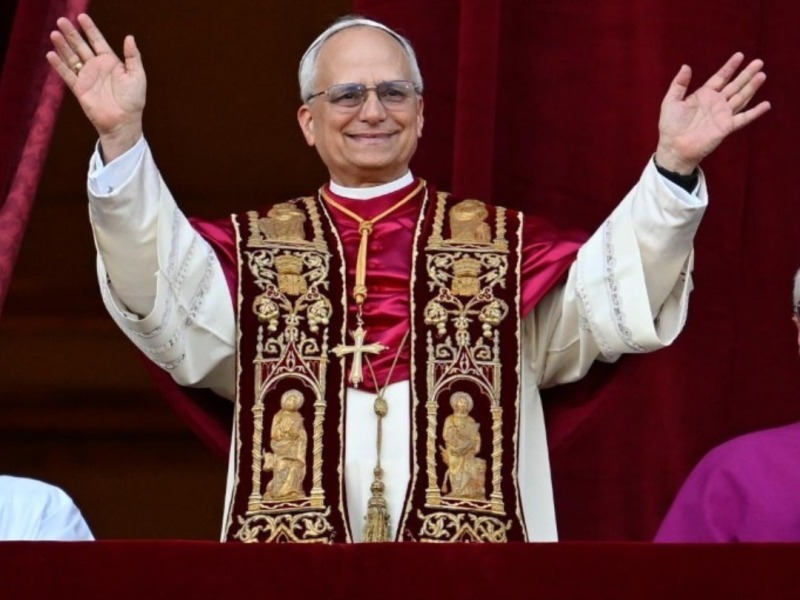
Habemus Papam! May Our Lord grant all the necessary graces and more for our new (American!) Pope, Leo XIV. As Catholics we have to be hopeful especially when a name like Leo is chosen. The first , Leo, Leo I or “the Great” (440-461) was a Lion of a Pope. He was a staunch defender of the Papacy:
“For even amongst the most blessed Apostles, alike in honor, there was a certain distinction in power. Although they were equal in being chosen, one was allowed to stand out above the others. From this arrangement there arose, also, distinction among the bishops,’ with superior authority being exercised by metropolitans and vicars, and through them the care of the universal church was to converge in the one see of Peter, and nothing was ever to be at odds with his leadership”.[1]
It’s more! In his sermons, Leo I identifies the Pope with Peter—in the legal sense of course—and hence the Pope is the direct inheritor of the powers that Christ conferred on Peter. The deep Roman legal mentality was able to flesh out the arguments well, leading to the defense of a strong centralized Church, monarchical as Christ had founded it.
Leo I also stood out for his firm orthodoxy. His Tome or Letter to Flavius, after much turmoil, was the basis of the central mystery of the Incarnation defended at Chalcedon, that Christ is one Divine Person with two distinct but inseparable natures, Divine and human. His doctrine was truly a synthesis between the heretical Christological extreme positions of Nestorianism and Monophysitism.
(More on Leo I in another article)
Let us jump from the first Leo to the last Leo (before Leo XIV of course), namely Leo XIII (1878-1903). He was another strong defender of doctrine, being the Pope who wrote the only encyclical against Freemasonry, called Humanum Genus, while defending Traditional Catholic doctrine (He also wrote a shorter encyclical called Inimica Vis). He was also anti-Liberal, Liberalism being intimately related with Freemasonry. Interestingly, and sadly, the Freemasons praised Pope Francis including after his death (!), that he aligned with the French Revolution ideals of “liberty, equality and fraternity”, these notions having a reductionist naturalism which is the essence of Freemasonry.
In the end, for Robert Francis Prevost to take the name Leo XIV, means a going back, a return to Tradition (capital “T”) in a certain or in some aspects, especially to Church centralization regarding, not so much the political realm (which is what Pope Francis stressed), but the doctrinal realm! Ultimately, truly good pastoral actions need sound doctrine as its basis.
It seems that not only doctrine, but theology itself has been distorted. Actually the doctrinal content has been perverted precisely because the method, theology, has been deformed. Hence to truly establish Tradition we need to establish traditional theology.
The distorted theology prevalent today, rooted in Modernism, the heresy of all heresies according to Pius X, is a mere inductive theology. It does not proceed from deducing truths from the principles given us from above, from Divine Revelation, as traditional theology has always been done. This “theology” stems from a reflection upon the praxis of man’s life, how he lives. For that reason, there are no more certain and valid truths for everyone. There is an absolute value given to experiences which have become the basis of forming the contemporary prevalent theology. As a modernist professor once told me: “Christianity is the fruit of the subjective experience of Jesus Christ”. Whatever that means.
This unsound theology is born from the praxis of the community, and, since there are many communities, there are many theologies which are all valid. Theology is reduced to the mere Christian reflection of our experiences. We don’t need content, that is, dogmas and creeds, we just need to be good in the Libertarian sense (“as long as I do no harm…” doctrine). This is essentially the religion of the Enlightenment, morality without doctrine.
I must say though that deduction cannot be done without induction, as the Church generally believes in the Aristo-Thomist epistemological principle: Nihil est in intellectu quod non sit prius in sensu, that is, “Nothing is in the intellect that was not first in the senses” (Philosophy is a remote object of Magisterial Infallibility!). Without getting into the problem of the first principles of knowledge, both deduction and induction are valid forms of knowledge. In fact, induction, knowledge of the concrete and then mentally arriving at universals, is the basis of deduction, from knowledge of universals to the concrete. In the end, it is true that there is no deduction without induction.
So theology is inductive since it stems from historical concrete events, salvific events. The problem is a merely inductive theology which turns into a subjective theology, precisely because it is closed to universal affirmations. And hence, “who am I to judge” becomes the standard in theology (Especially moral) because there is no transcendence of the concrete, subjective realm. This is a danger that needs to be eradicated an I hope the new Pope addresses it.
There is a sound way to do a more inductive, subjective theology that reverses the order but still has as its goal the universal affirmations of doctrine. This applies especially to moral theology which is in such dire need of restoration though this can end up seeping into Dogmatic theology which it does actually. So from lived experience we can deduce universal truths without falling into a subjective emotivism. John Paul II is his Personalist philosophy, very much based on his phenomenology, sought to focus on the subjective interiority of the person, not separate from objective reality and universal principles, but as a reality based on and rooting in the objective realm. Basically, you cannot divorce the subjective realm from the objective, but you can see the subjective as subjective and there’s nothing wrong with that. This is the profound novel insight of JPII’s doctrine, since subjectivity was rarely looked at in traditional Catholic philosophy and theology.
Though JPII’s thought was sound, subjectivity has unfortunately led to subjectivism, to “the dictatorship of relativism” coined by Pope Benedict XVI. Inductive theology has been reduced and enclosed to the concrete, the subjective.
What we need is to turn the tide towards an emphasis on deductive theology, one that stresses the universal realm. The praxis, in order to be sound, needs a sound theory. Focusing just on the practical or pastoral while marginalizing the theory leads in the end to an unsound or disordered practice, as one cannot play music well without a good knowledge of (universal) music theory.
We do not want to fall into a type of Platonic abstractionism in which we give actual reality and independent existence to universals. But we do want to focus on the universal as stemming from the concrete. The universal is hidden in a sense behind the concrete thing and act. We need the orthodox intellectualism to transcend concrete things to arrive at the universal, which is simply the philosophical method. We have lost true philosophy, which teaches us how to live! Only universal truths save us from relativism and nihilism. They give meaning to our lives!
The perfect synthesis is God Himself. Though He be a concrete and singular being, he is universally present in all things, having his greatest presence, His substantial presence here on earth solely in the Most Holy Sacrament of the Altar!
Let us pray for this essential change in theology. (More on the topic coming)
[1] Leo, ep. 14, ed. Ballerini, I, 682-691; trans. Hunt, 66.
